

Short answer: the best time to visit Balabac is February to April, and April is the best single month. That window has the most dry days and the most sunshine, with low typhoon risk, and April’s seas are calmer than February’s and March’s. October to December is the wettest stretch in Balabac, even though many guides call it “dry season.”
For Coron and El Nido in northern Palawan, January to April is the best season and February is the best month. Their wettest months are June to September or October, while Balabac’s are October to December.
| Destination | Best season | Best month | Wettest months | Driest month |
|---|---|---|---|---|
| Balabac (south) | February to April | April | October to December | March (21 dry days) |
| Coron (north) | January to April | February | June to September | March (28 dry days) |
| El Nido (north) | January to April | February | June to October | March (26 dry days) |
Updated October 2026 · By The Wanderwalkers, running Balabac tours since 2018
Have you ever booked what you thought was the best weather month, then got rain all week? Or braced for bad weather and got blue skies instead? If you’re planning a trip to the Philippines, either can happen to you.
Since we started running Balabac tours in 2018, we’ve welcomed many guests who picked an Amihan month (November to February) because a website called it dry season. Having the right expectations is what makes a trip enjoyable, and this guide will help you set them.
Philippine weather information is scattered and often contradictory, so we’ve put it in one place. It’s written for Balabac travelers, but we hope anyone heading to the Philippine islands finds it useful. We start with the country’s climate zones, zoom in on Palawan, then look closely at the best time to visit Coron, El Nido and Balabac, month by month.

Contents
- The Philippines and its four climate zones
- Palawan weather: why north and south differ
- Best time to visit Coron, Palawan
- Best time to visit El Nido, Palawan
- Best time to visit Balabac, Palawan
- What about monsoons and climate change?
- Conclusion: expect everything, and plan for it
- FAQ: best time to visit Balabac, Coron and El Nido
The Philippines and its four climate zones
“Dry season November to May” is only true for part of the Philippines. The country sits in the tropics, so it has two seasons, dry and wet. Sounds simple: pick a dry month and go. Not quite.
Many websites summarize Philippine weather like this:
- Dry season: November to May
- Wet season: June to October
Even PAGASA, the national weather agency, gives a national summary: rainy season June to November, dry season December to May. But that is an average across very different regions. PAGASA divides the country into four climate types based on how rainfall is spread across the year. Check the climate zone map below.
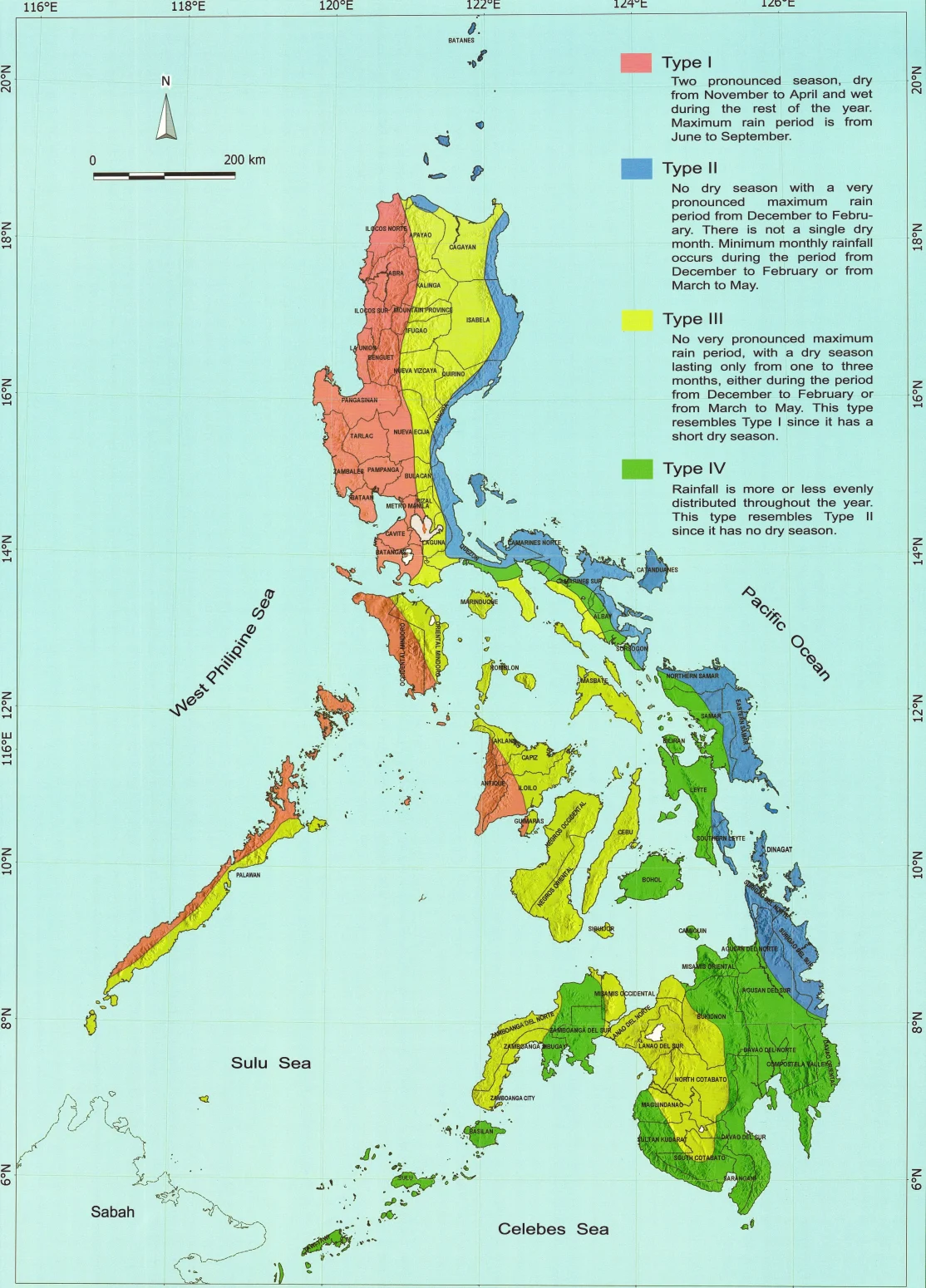
Type I. Two pronounced seasons: dry from November to April, wet the rest of the year. The heaviest rain falls from June to September.
Type II. No dry season, with a very pronounced rainy period from December to February. There is not a single dry month.
Type III. No very pronounced rainy peak, with a short dry season of one to three months, either December to February or March to May. It resembles Type I because it has a short dry season.
Type IV. Rainfall is more or less evenly spread throughout the year. It resembles Type II because it has no dry season.
Where each climate type applies
Type I: two pronounced seasons (dry November to April, wet May to October). Red areas on the map: western Philippines and west-facing coasts.
- Metro Manila, Cavite and Bulacan
- Northern and western Palawan (Coron, El Nido, San Vicente)
- Ilocos Region (Vigan, Laoag)
- Zambales (Subic, Anawangin Cove)
- Bataan (Mt. Samat, beaches)
- Western Batangas (Nasugbu, Anilao)
- Southern Panay (Iloilo City, southern Antique)
Type II: no dry season, very wet December to February. Blue areas: the eastern seaboard facing the Pacific.
- Catanduanes (surfing, beaches)
- Eastern Samar (Calicoan surf)
- Surigao del Sur (Tinuy-an Falls, Enchanted River)
- Siargao (the country’s surfing capital)
Type III: short dry season, rainfall not extreme. Yellow areas: inland and partly sheltered areas.
- Eastern and southern Palawan (Balabac, Puerto Princesa, Araceli)
- Oriental Mindoro (Puerto Galera)
- Eastern Batangas (Laiya)
- Aklan and Capiz (Boracay)
- Cebu City and Siquijor
Type IV: rainfall spread evenly all year. Green areas: southern Mindanao and scattered zones.
- Bohol (Panglao Island)
- Baler, Aurora (surfing)
- Davao (Samal Island, Mount Apo, Philippine Eagle Center)
- Leyte (Kalanggaman Island)
- General Santos and South Cotabato
Palawan weather: why north and south differ
Palawan is about 450 km long, so its north and south don’t share a weather calendar. Coron and El Nido at the northern tip are Type I. Balabac at the southern tip is Type III. Here is the general pattern most guides describe for the whole province:
| Season | Months | What to expect |
|---|---|---|
| Cool dry season (Amihan) | December to February | Northeast winds, breezy and slightly cooler. The north is dry; the south still gets regular showers. |
| Hot dry season | March to May | Hottest, driest and calmest. Peak travel season. |
| Rainy season (Habagat) | June to September | Southwest monsoon rain and rougher seas on west-facing coasts. Most typhoon activity is in the north. |
| Transition | October to November | The monsoons switch. Calm spells mixed with heavy showers. |
Most blogs stop here. But what the north gets can be very different from the south, and this is where wrong expectations come from. The chart below compares the average number of dry days per month in all three destinations.
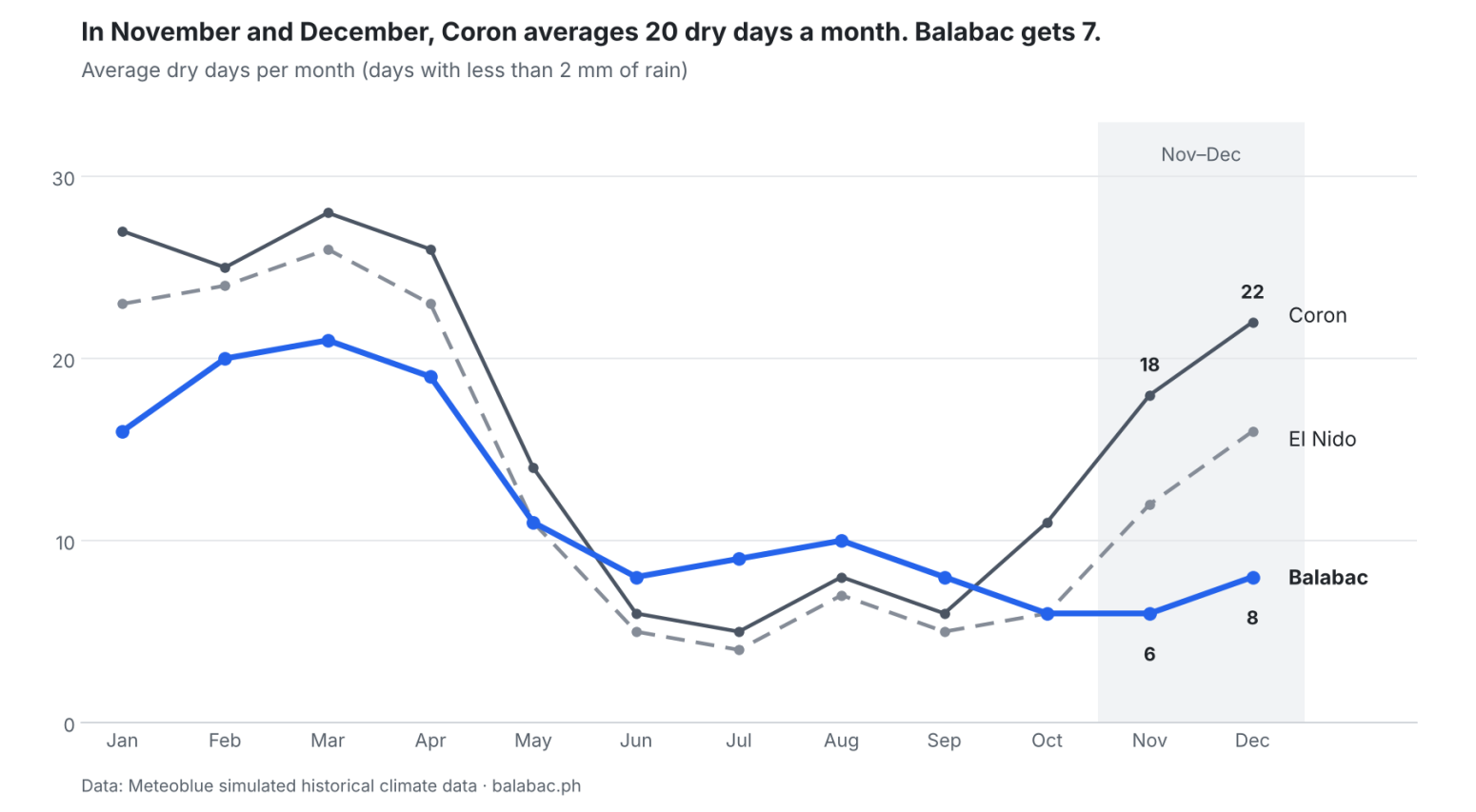
In November and December, Coron averages 20 dry days a month while Balabac averages 7. From June to September it flips: Balabac gets 8 to 10 dry days a month, Coron 5 to 8. So “Palawan’s dry season” depends on which end of Palawan you mean.
A “dry day” here means less than 2 mm of rain. A day with one short afternoon shower doesn’t count as dry, so a month with 8 dry days is not 22 days of all-day rain.
Best time to visit Coron, Palawan
February is the best month to visit Coron, and January to April is the best season. Based on PAGASA and Meteoblue historical climate data, here are your options.
Best season: January to April. February has the least rain, minimal typhoon risk, and tourist numbers below the peak. January to April has the most dry days, and February to April gets the most sunshine. Expect Amihan winds of Beaufort 4 (20 km/h or more, enough for choppy water) on most days, but the chance of a typhoon stays low, so tour interruptions are rare. It’s the most comfortable time for island hopping, shipwreck diving and swimming in the lagoons. March and April are peak tourist season: hotel rates rise and the popular spots get crowded.
Budget pick: May and November. These shoulder months are often the best time to go to Coron on a budget. The weather is still manageable, with lighter crowds and cheaper stays. Rain showers happen but are usually brief.
Avoid if you can: June to September. These months have the most rain, stronger Habagat winds and the most typhoons. Prices are low, but it’s not ideal for first-timers who want to see Coron at its best.
Coron weather by month
Use the table below to set your expectations for each month in Coron.
| Month | High / low °C (°F) | Water °C (°F) | Dry days (<2 mm rain) | Storms entering PH waters (national avg, 1948–2024) | Days ≥ Bft 4 (≥20 km/h) | Sunniest months |
|---|---|---|---|---|---|---|
| January | 29 / 24 (84 / 75) | 27 (81) | 27 | 0.4 | 23 | — |
| February | 29 / 24 (84 / 75) | 27 (81) | 25 | 0.3 | 22 | ✔ |
| March | 30 / 25 (86 / 77) | 28 (82) | 28 | 0.3 | 23 | ✔ |
| April | 31 / 25 (88 / 77) | 29 (84) | 26 | 0.5 | 21 | ✔ |
| May | 31 / 26 (88 / 79) | 30 (86) | 14 | 0.9 | 15 | — |
| June | 30 / 26 (86 / 79) | 29 (84) | 6 | 1.5 | 24 | — |
| July | 29 / 26 (84 / 79) | 29 (84) | 5 | 3.2 | 21 | — |
| August | 29 / 26 (84 / 79) | 29 (84) | 8 | 3.0 | 17 | — |
| September | 29 / 25 (84 / 77) | 29 (84) | 6 | 3.1 | 15 | — |
| October | 29 / 25 (84 / 77) | 29 (84) | 11 | 2.6 | 13 | — |
| November | 30 / 24 (86 / 75) | 28 (82) | 18 | 2.0 | 18 | — |
| December | 29 / 24 (84 / 75) | 27 (81) | 22 | 1.3 | 21 | — |
Best time to visit El Nido, Palawan
February is also the best month to visit El Nido, within a January to April best season. Coron and El Nido are both in northern Palawan, so their weather is very similar. Based on PAGASA and Meteoblue historical climate data, here are your options for El Nido.
Best season: January to April. February has the fewest rainy days and minimal typhoon risk, while March and April get the most sunshine. Expect Amihan winds of Beaufort 4 on many days, but typhoons are unlikely, so tour cancellations are rare. It’s ideal for island hopping, kayaking, snorkeling and El Nido’s famous beaches. March and April are peak tourist season, with higher room rates and bigger crowds.
Budget pick: May and November. Like Coron, these shoulder months suit budget travelers: good water, lighter crowds and lower rates. Showers usually clear up fast.
Avoid if you can: June to September. These are the wettest months, with stronger monsoon winds and occasional typhoon-related cancellations. Not ideal for first-time visitors.
El Nido weather by month
Use the table below to set your expectations for each month in El Nido.
| Month | High / low °C (°F) | Water °C (°F) | Dry days (<2 mm rain) | Storms entering PH waters (national avg, 1948–2024) | Days ≥ Bft 4 (≥20 km/h) | Sunniest months |
|---|---|---|---|---|---|---|
| January | 30 / 23 (86 / 73) | 27 (81) | 23 | 0.4 | 24 | |
| February | 31 / 23 (88 / 73) | 27 (81) | 24 | 0.3 | 22 | ✔ |
| March | 32 / 24 (90 / 75) | 28 (82) | 26 | 0.3 | 23 | ✔ |
| April | 33 / 25 (91 / 77) | 29 (84) | 23 | 0.5 | 17 | ✔ |
| May | 33 / 25 (91 / 77) | 30 (86) | 11 | 0.9 | 8 | |
| June | 32 / 25 (90 / 77) | 29 (84) | 5 | 1.5 | 6 | |
| July | 31 / 25 (88 / 77) | 28 (82) | 4 | 3.2 | 10 | |
| August | 30 / 25 (86 / 77) | 28 (82) | 7 | 3.0 | 11 | |
| September | 30 / 25 (86 / 77) | 28 (82) | 5 | 3.1 | 10 | |
| October | 31 / 25 (88 / 77) | 28 (82) | 6 | 2.6 | 10 | |
| November | 31 / 24 (88 / 75) | 28 (82) | 12 | 2.0 | 17 | |
| December | 30 / 23 (86 / 73) | 27 (81) | 16 | 1.3 | 23 |
Best time to visit Balabac, Palawan
April is the best month to visit Balabac, and February to April is the best season. Those months average 19 to 21 dry days, while October and November average only 6. April also has the calmest seas of the dry season, which matters on a trip built around long boat crossings.
Temperatures barely change through the year: highs of 30 to 33°C, lows of 24 to 26°C, and water at 28 to 30°C. What changes is rain and wind.
Best season: February to April. These are the driest and sunniest months of the year, with low storm risk. February and March are still breezy from the Amihan, with Beaufort 4 winds on about 22 days a month. March is the driest month (21 dry days).

Best month: April. It’s the sunniest month, with 19 dry days and only 16 windy days, so crossings to Onok Island and the sandbars are usually smoother. It’s also the hottest month, with highs around 33°C, so pack sun protection.
Calm-water pick: May. May has the fewest windy days of the year (14), and the sea is often glassy. The trade-off: rain returns, with 11 dry days, mostly as afternoon showers.

Shoulder month: January. It has 16 dry days, but the Amihan blows on most days (25), so expect choppier crossings.
Off-season: June to September. The Habagat brings 8 to 10 dry days a month, and September is the windiest month (26 windy days). Still, Balabac is usually drier than Coron and El Nido in these months, and almost empty of other visitors.
Wettest stretch: October to December. These months average just 6 to 8 dry days. October is a transition month and can surprise: in October 2024, our guests caught calm, sunny days right between the two monsoons. November and December bring the Amihan back with rain and wind. This is the window many guides call “dry season,” which is why we meet so many surprised guests.
December to April, or March to May?
Other guides disagree on the best time to visit Balabac. Some say December to April; others say March to May. Both are partly right.
December to April is northern Palawan’s dry season, and most travel writers base their advice on Coron and El Nido. For Balabac, the data points to February to April for dry weather and April to May for calm water. Where those overlap, in April, is the safest bet. December is the odd one out: in Balabac it averages just 8 dry days.
Does Balabac get typhoons?
Rarely, but it isn’t immune. PAGASA notes that typhoons usually move northwest, so most of them miss the southern Philippines. Balabac sits far south, at the latitude of northern Mindanao. The storms that do reach the far south tend to come late in the year: Tropical Storm Vinta (Tembin) made landfall in Balabac on December 23, 2017. For everything else about safety, read Is Balabac safe?
Balabac weather by month
| Month | Dry days (<2 mm rain) | Windy days (≥ Bft 4, ≥20 km/h) | Weather and sea | Crowds | Our take |
|---|---|---|---|---|---|
| January | 16 | 25 | Mostly fine; Amihan breeze makes crossings choppy | Quiet after New Year | Good |
| February | 20 | 22 | Dry, breezy and among the sunniest | Quiet | Very good |
| March | 21 | 22 | Driest month; among the sunniest; still breezy | Holy Week (March 21 to 28, 2027) books out early | Very good; book Holy Week early |
| April | 19 | 16 | Sunniest month; dry, hot (around 33°C) and calmer | Busiest: school break and long weekends | Best month |
| May | 11 | 14 | Calmest seas; afternoon showers return | Busy (school break) | Good for calm water |
| June | 8 | 15 | Habagat starts; showers and some rough days | Very quiet | Off-season |
| July | 9 | 18 | Showery; mixed seas | Very quiet | Off-season |
| August | 10 | 17 | Showery; mixed seas | Very quiet | Off-season |
| September | 8 | 26 | Windiest month; rough crossings likely | Very quiet | Off-season |
| October | 6 | 15 | Transition; heavy showers with calm spells | Very quiet | A gamble |
| November | 6 | 18 | Amihan arrives; among the wettest months | Quiet | Avoid if you can |
| December | 8 | 22 | Wet and windy | Christmas and New Year demand | Avoid if you can |
Even “busiest” is relative here. Balabac ranked 10th in Palawan for overnight guest arrivals from January to June 2026, with 8,248, against 345,801 in El Nido and 149,962 in Coron (Palawan Provincial Tourism Office, via Palawan News).
What this means for your Balabac tour
- We run tours all year, so you can come even outside the best time to visit Balabac. Just match your expectations to the table above.
- On rough days, our boats stay close to the islands instead of crossing open sea.
- If the coast guard suspends boat trips because of a storm, as it can anywhere in Palawan, you can choose a new date or a refund.
- See our group tour dates, or choose a private tour to pick your own dates.
What about monsoons and climate change?
Two monsoons drive most of Palawan’s weather, and climate change is making both harder to predict. Whew! We’ve laid out the climate data. It would be nice if the weather stayed inside those boundaries, right? But the monsoons decide how rain and wind actually play out.
- Amihan (northeast monsoon), roughly November to March. Cooler, steady winds from the northeast. In northern Palawan this is the dry season. In Balabac it brings showers from November to January and breezy seas until March.
- Habagat (southwest monsoon), roughly June to September. Warm, moist winds from the southwest bring most of the country’s rain; a PAGASA weather specialist puts it at about 60%. Expect rougher seas on west-facing coasts.
So a “dry” month on a chart is never a guarantee. Even in November to February, rain is possible anywhere in the Philippines, and in Balabac those Amihan months are among the wettest of the year.
Climate change is very real to us, too. In Balabac, we now sometimes get rain in March, a month that used to be reliably dry. Typhoon seasons have also become irregular in recent years. El Niño years also tend to be drier than usual and La Niña years wetter, so check PAGASA’s El Niño and La Niña advisories a month or two before your trip.
Conclusion: expect everything, and plan for it
If you can choose, the best time to visit Balabac is February to April, ideally April. If you can’t, come anyway with the right expectations.
We get it: most of us can only travel at certain times of the year, and that comes first. You don’t usually google the “best month” for a bucket-list destination and then book exactly that. Unless, of course, you’re a digital nomad, a CEO, or a rich kid who can travel any time of the year.
For everyone else, here’s how to make any month work:
- Pick the best window you can. February to April for dry weather, April to May for calm seas. Book early for Holy Week and summer long weekends.
- Expect showers, not washouts. In Balabac’s wetter months, most rain comes as passing showers, and you’ll have the islands almost to yourselves.
- Add a buffer day before your flight home. Balabac is a 6-hour drive plus a boat ride from Puerto Princesa (how to get to Balabac), and weather can delay a return crossing.
- Check the forecast a week out. Follow PAGASA’s tropical cyclone bulletins, and its El Niño and La Niña outlook a month or two before.
- Pack for both sun and rain. A light rain jacket, a dry bag for your phone, and reef-safe sunscreen.
- Know the weather policy before you book. If the coast guard suspends boat trips, ours lets you choose a new date or a refund.
- Consider travel insurance that covers weather delays.
You can’t choose the weather, but you can choose your expectations. Bring the right ones and Balabac will still take your breath away.
Planning a trip? Message us on Facebook Messenger or Instagram, tell us your month, and we’ll tell you honestly what to expect.
FAQ: best time to visit Balabac, Coron and El Nido
What is the best month to visit Balabac?
April. It averages 19 dry days and has the calmest seas of the dry season. March is the driest month, with 21 dry days, but it’s breezier.
Is December a good time to visit Balabac?
Not for weather. December averages only 8 dry days, with Amihan winds on most days, and Tropical Storm Vinta made landfall in Balabac in December 2017. Northern Palawan is much drier in December.
Can you visit Balabac in the rainy season?
Yes. We run tours all year. From June to October, expect 6 to 10 dry days a month, some rough days at sea and very few other visitors.
Does Balabac get typhoons?
Rarely. Most typhoons move northwest and miss the far south of the Philippines, but late-year storms can reach Balabac, as Vinta did in 2017.
Is the best time to visit Balabac the same as El Nido and Coron?
No. Coron and El Nido are driest from about November or December to April. Balabac’s dry season is shorter, February to April, and Balabac is much wetter than the north in November and December.
When is peak season in Balabac?
March to May, especially Holy Week and the April to May school break. Even then, Balabac gets a tiny fraction of El Nido’s visitors.
What is the best month to visit Coron?
February. It has the fewest rainy days and low typhoon risk, before the March to April crowds. March and April are sunnier but busier.
When is the rainy season in El Nido?
June to October. El Nido averages only 4 to 7 dry days a month then, with stronger southwest winds. July is the wettest month.
What is the weather like in Palawan in December?
It depends on where you go. December is mostly dry in the north (22 dry days in Coron, 16 in El Nido) but wet in the south (8 in Balabac).
When is typhoon season in Palawan?
PAGASA puts the national peak at July to October. Palawan is not among the provinces most often hit, and storms affect the north and center more, but late-year storms can reach the south, as Vinta did in December 2017.
Sources
- PAGASA: Climate of the Philippines (seasons, climate types, typhoon tracks)
- PAGASA: Tropical Cyclone Information (national monthly averages of storms entering Philippine waters; July to October peak)
- Meteoblue simulated historical climate data for Coron, El Nido and Balabac
- Philstar: “Vinta” leaves PAR (landfall in Balabac, December 2017)
- Palawan Daily News: PAGASA forecasts four weather disturbances this October (Palawan not among the provinces most often hit; north and center more affected)
- Edge Davao: That thing called weather (PAGASA specialist on monsoon rainfall and climate types)
- Palawan News: Palawan logs 1.08 million tourist arrivals in first half of 2026 (overnight guest arrivals by destination, January to June 2026, from the Palawan Provincial Tourism Office)


